Music Theory for Songwriters (With Playable Examples)
By Chorus ·
Learning music theory can seem like a daunting task, but it's easier than many people would have you believe.
Learning a little bit of theory goes a long way when it comes to songwriting. The more you know, the less you'll get stuck and have to guess at things.
This guide aims to give you the knowledge and tools to help you write chord progressions for your songs, without getting stuck. It touches on the basics of notation, which chords we can use, what they do, and how to use them.
All you really need to know here is the difference between major and minor chords, and what a C major scale is.
Everything here is in C major, but the numbers work the same way in any key, so what you learn here transfers straight to your own songs.
Roman numeral chord notation
How do we communicate chords using numbers?
A chord number tells you where the chord sits in the key. In C major the I chord is C, and in G major it's G. The notes are different, but the I chord feels like home in both keys, which is why it's useful to think in numbers rather than chord names.
Roman numerals are just the usual way of writing those numbers down. Capitals are major chords, lowercase numerals are minor, and a little circle means diminished.
There is another notation system called the Nashville Numbering System but we'll stick to the Roman Numeral system here.
Here are the seven chords that fit in the key of C major. These are called the diatonic chords of the key.
The seven chords of C major
Minor keys have their own set of seven chords. The same numbering idea applies, and we'll stick with major here so the examples stay simple.
Chord function
What are the different chord functions?
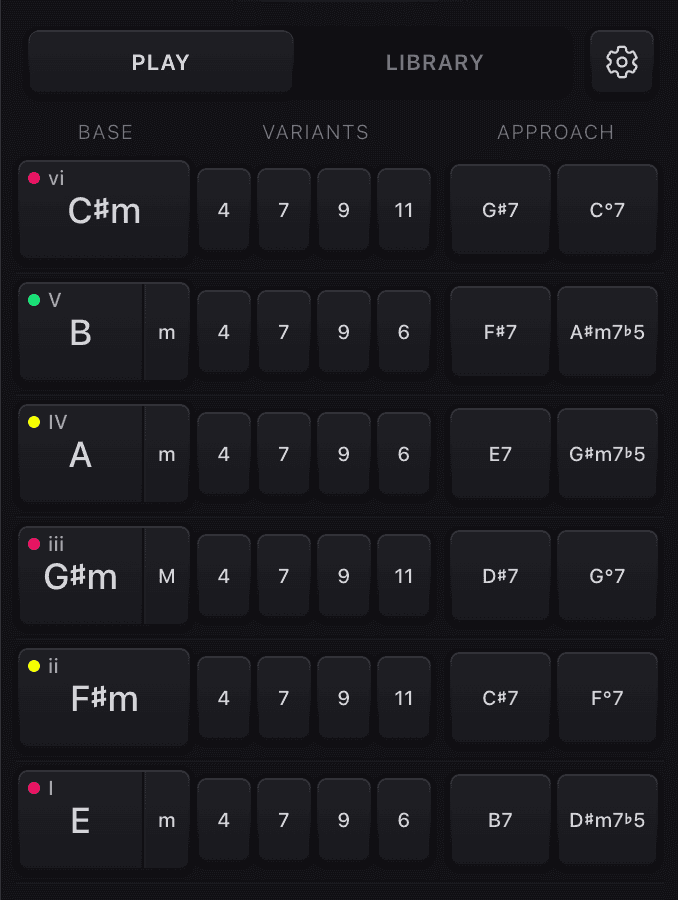
You've probably noticed the chords above are colored. Here's what each color stands for.
Tonic
Predominant
Dominant
Borrowed
Red is the tonic. These chords feel restful and that a phrase can end on them.
Yellow chords are predominant. They feel like you're moving, but not quite there yet. They have a small amount of tension that needs to be resolved.
Green is called the dominant. Dominant chords have a lot of tension, meaning that they really want to pull you to another chord – in this case the I chord.
Purple chords are borrowed from the parallel minor key (C minor is the parallel minor of C major) and give surprise and color. We'll come back to these later.
A line that goes red, yellow, green and back to red usually sounds natural, and you'll hear it a lot in popular music. You will also hear red, yellow, red, which gives the feeling of moving slightly away from home before returning, but without the big pull of the dominant chord.
A common progression: I-IV-V
You can swap in a different red chord and a different yellow one and keep the same shape. Here vi stands in for I and ii stands in for IV, and the green chord still pulls you back home at the end.
Different choices but the same motion
Cadence
How do chords pull towards each other?
Different chords have a different pull towards other chords in the key, depending on the differences in the notes. We usually talk mostly about resolving back to the I chord.
The dominant (green) has the strongest pull of any chord in the key, especially when it's a V7 chord. This is because it has two notes that are one semitone away from the notes in the I chord.
The 'authentic' cadence: V7-I
You can land from a yellow chord too. IV–I still gets you home, but there's less tension going into it, so it sounds gentler than V–I.
The plagal cadence: IV-I
Other chords have their own pulls that give a different feel as you move back to the home chord.
Borrowed chords
How can I write more interesting chord progressions?
The purple chords are borrowed from the parallel minor, so in C major you'd borrow them from C minor. You're still in C the whole time; you're just using a few chords from outside the major scale to get a darker or bigger sound.
The most commonly used borrowed chords are iv, ♭VII, ♭VI, and ♭III, which in C are Fm, B♭, A♭, and E♭.
Even with these in the mix, I still sounds like home, so they work as a short trip away rather than a key change.
Here are some examples of borrowed chords in use.
Using the bIII before the IV gives a powerful sound, commonly used in rock music.
A powerful line using bIII before IV
The whole-tone steps between bVI, bVII and I give a big lift, which is great for a bridge or prechorus.
A big lift using bVI, bVII and I
Here vi drops a half step onto bVI, then another half step onto V, and that stepwise fall is a big part of why the resolution to I feels so satisfying.
The half-step fall
Chord extensions and variations
How do we make chords sound more interesting?
An extension adds extra notes to a chord without changing its number. IMaj7 and Iadd9 are both still the I chord, so they keep the same red color in our system, but they sound different from a plain I.
The extension numbers are just the note number in the scale of the note you are adding. So the 9 of a C major chord is the 9th note in the C major scale which is a D. You can do the same for any other, like 6, 11 and 13.
Each extension brings its own character, and you'll need to play around with them to get a feel for them. They can feel jazzy, soulful, sweet, dark, lush, or anything in between.
Five flavors of I
Five flavors of iii
If you put sevenths on I–vi–ii–V, the progression moves the same way it did before, but it sounds smoother.
Sevenths adding a smooth sound
Extensions can be combined and altered to add more complexity to your chords, giving you more crunchy, jazzy sounds.
Passing chords
How can I make chord progressions flow more naturally?
A passing chord is often from outside the key's chords and helps you get from one chord to another.
Let's start with a basic loop using plain diatonic chords.
A basic loop with no passing chords
Now we'll add passing chords so there's a push into each change.
Remember our green, dominant chord in the key of C major? It's the number 5, and it moves very smoothly back to the I chord. Well, we can use the same idea to lead us to any other chord.
Just go one fifth above the chord you're heading to, and you have what's called a secondary dominant. These are written with a V/ in front of your target chord, so the secondary dominant of the IV would be written as V/IV.
They are often played as a 7th chord, and written like this: V7/IV
With secondary dominants
There are a number of other passing chords you can use, but the secondary dominant is a good one to start with because it's very versatile and easy to understand.
Putting it together
A verse and a bridge
Here's a verse with a turnaround leading into a bridge. Listen to it and then we'll analyse it afterwarrds.
A verse and bridge showing the principles we've covered
Verse
Turnaround
Bridge
The verse sticks to to a basic I–IV loop. Just because you've learned some theory doesn't mean you have to make everything complicated!
The turnaround looks complex but it's just a V–IV with some passing chords: a secondary dominant before the IV, and a secondary dominant of the first chord of the bridge.
The bridge starts with minor 9 chords, which I find have a wamr but melancholy sound. It loops between the iii and vi chords, which are both tonic (or "home") chords. It sounds like we're in a new home, but it just kind of floats there.
The final two bars of the bridge use borrowed chords with some warm extensions to give a big lift, bringing us back to the original home on the I.
Next steps
Putting the theory to work
Try just one idea in a song you're working on this week. Hearing it in your own writing will teach you more than reading.
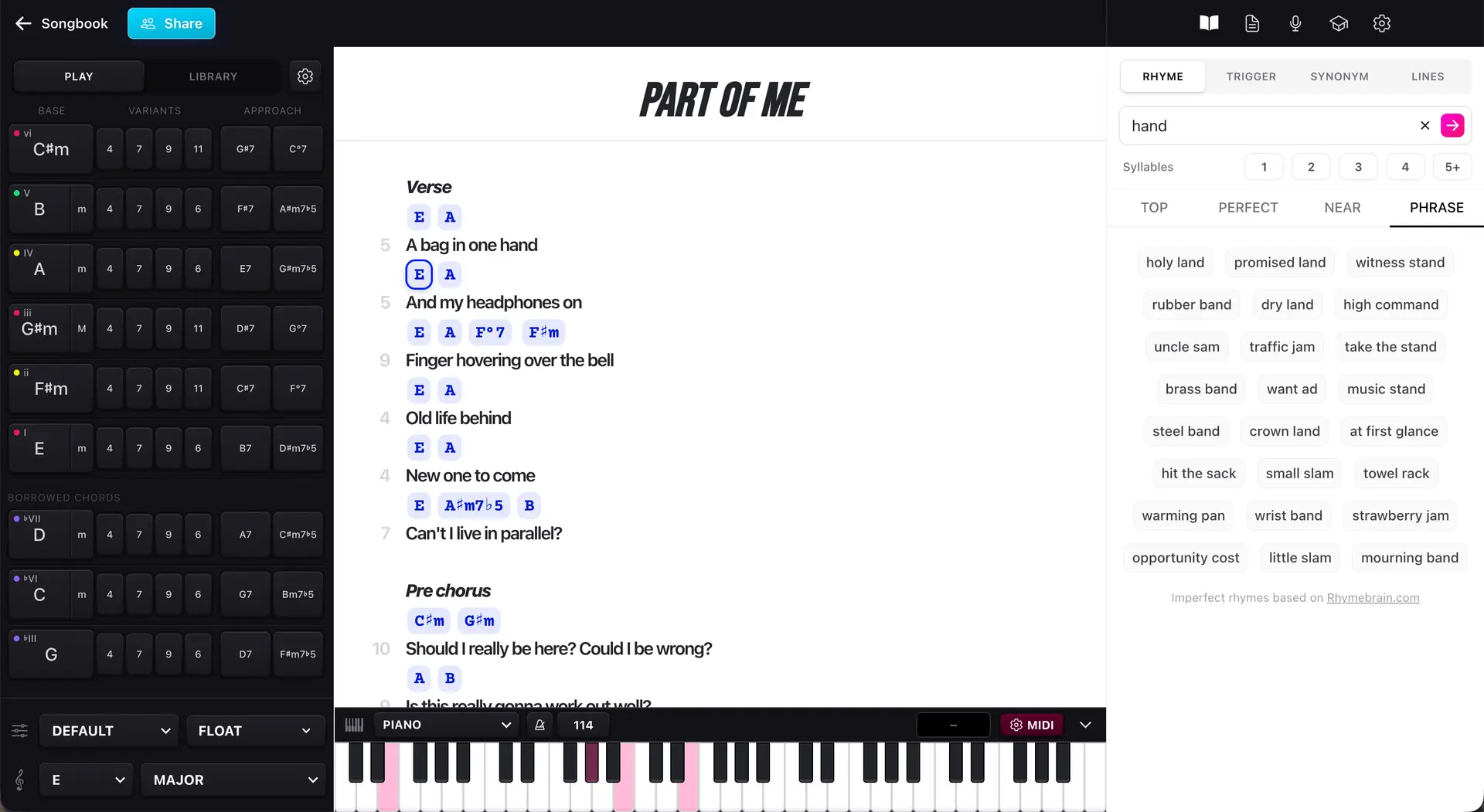
That's what Chorus is for. It's a songwriting app for your laptop, tablet and phone, built to help you write better songs.
It has all of this and more built in. It works for every key, you can see the notes being played and you can drag them into your song to build your song.
Try this in a song
Use the chord pads in Chorus, with chord function colors, extensions, parallel minors and passing chords. All designed to help you write your best songs.