Phrase Rhymes: How to Write Better Lyrics Than a Rhyming Dictionary Gives You
10/14/2026
Everyone has got stuck for a rhyme at some point and gone to an online rhyming dictionary for help. But that's usually not the end of the problem.
Search for a rhyme for "night," and you might get "light," "right," and "fight." Those words match the sound, but they leave the harder question unanswered: what should the next line actually say?
Compare those results with "left the light," "get it right," or "another fight." Now you have actions and situations to develop, not just words to fit at the end of a line.
That's the practical advantage of phrase rhymes: rhymes that come as short, usable phrases rather than isolated words. Here's how to use them to write more specific lyrics, explore different rhythms, and get more from a songwriting rhyming dictionary.
In this article:
- Why single-word rhyme lists leave you stuck
- What are phrase rhymes?
- Perfect rhymes vs. near rhymes
- How to rhyme more than the last word
- A worked example: rewriting one line
- How to find phrase rhymes as you write
- FAQ
Why single-word rhyme lists leave you stuck
A matching word doesn't give you a complete idea. Suppose your line ends with "phone." A single-word rhyme list might suggest "alone," "known," and "stone." You still have to build the situation around whichever word you choose.
That means you now have a handful of words and still no line to put them in. Any one of them might be perfect, if only you could think of the words before it that make it make sense. You've got two jobs to do instead of one: find the rhyme, then work out what leads into it.
What are phrase rhymes?
Phrase rhymes are rhyming results that include an action, an object or an image, not just a final word. Because the result already carries some meaning, you can test it against your song's situation immediately.
Say you have a line that ends with "home." Consider these endings:
- "dirt road": a physical setting.
- "heart and soul": an emotional pull.
- "wind blows": a sensory detail. Each could rhyme with "home," and each takes the next line somewhere different. Compare that with the bare final words: "road," "soul," "blows."
It's a world of difference. You have ready-made imagery, scenes and feelings that are much easier to shape into lines that fit your story. It's also easier to reject the ones that don't work, which helps you finish more songs instead of leaving your best ideas stranded.
Perfect rhymes vs. near rhymes
You may have noticed that "dirt road," "heart and soul" and "wind blows" don't rhyme with "home" in the strict, textbook sense. They share the long "o" vowel, but the final consonants differ. That's a near rhyme, also called a slant rhyme or half rhyme.
Perfect rhyme
What matches: the last stressed vowel and every sound after it.
Example for "home": Rome, foam, comb.
Feel: neat, resolved, sometimes predictable.
Best for: hooks, simple sing-along lines, and a strong sense of closure. Near (slant) rhyme
What matches: usually the vowel or the consonants, not both.
Example for "home": phone, road, soul, blows.
Feel: looser, more conversational, more modern.
Best for: verses, storytelling, and avoiding a sing-song sound. Near rhyme isn't a compromise. It's how a great deal of contemporary lyric writing works, because it lets you choose the best image rather than the only word that fits. Phrase results in a rhyming dictionary will often include both kinds, so it helps to know which you're looking at and which your song needs.
A rule of thumb: use perfect rhymes where you want a line to land with certainty, and near rhymes where you want the meaning to lead and the sound to follow.
How to rhyme more than the last word
Try a multi-word (multisyllabic) rhyme
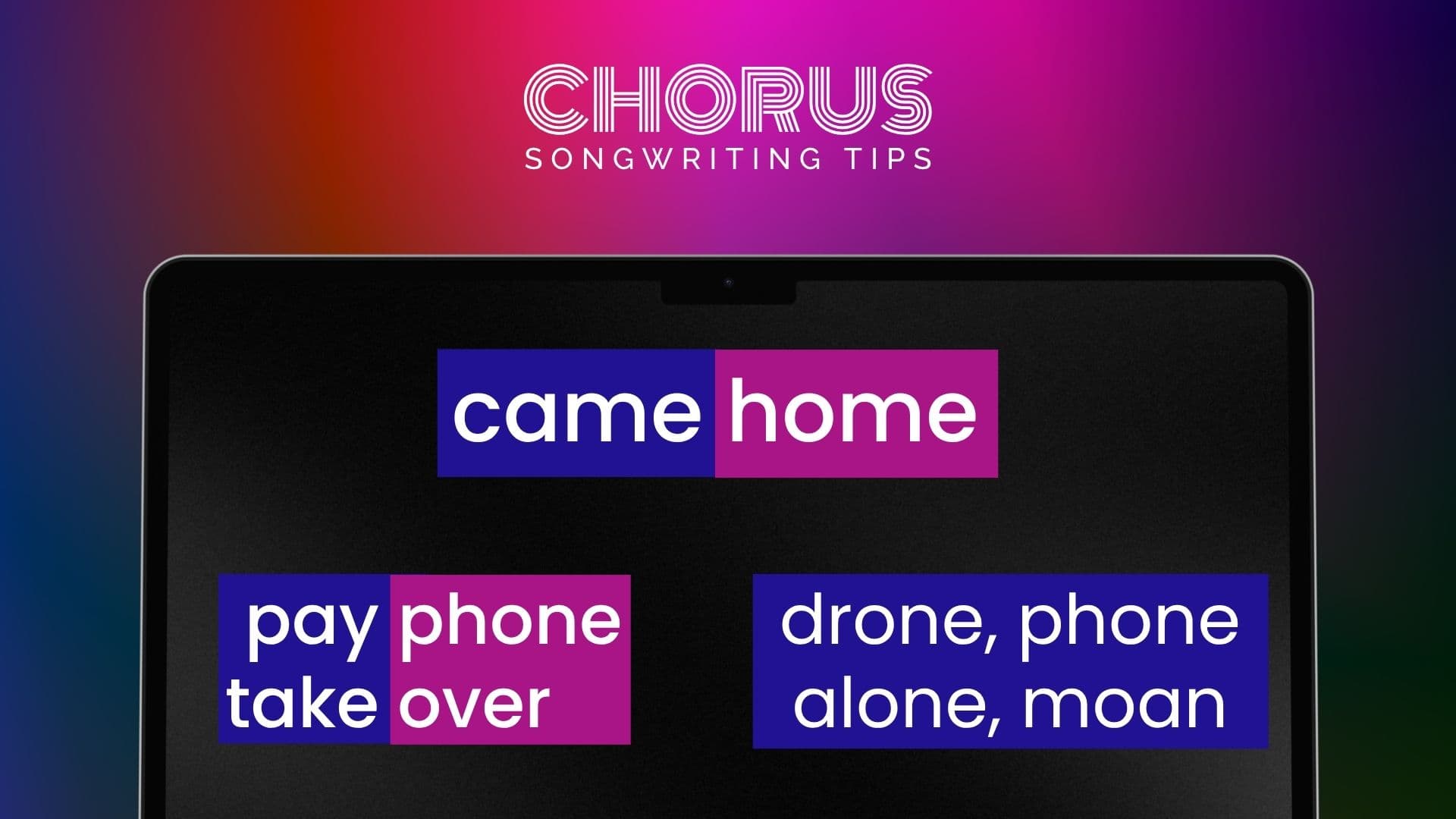
Phrases also let you match more than one word. Say the line is "It's been two weeks since you came home."
A multi-word rhyme, sometimes called a multisyllabic rhyme, matches several syllables rather than only the final one. To find one, count back the last two or three syllables of the line and try to rhyme those. The more syllables you try to match, the fewer perfect matches exist, so this is where near rhymes become especially useful.
Some phrases that echo "came home":
- "pay phone"
- "baby clothes"
- "break the hold"
- "laid low" These match the vowel sounds across more than one word, and they instantly give you choices about the emotional or thematic direction to take. They're near rhymes rather than exact ones, and that's the point: you get the sonic echo of two words without being forced into a single predictable answer.
Notice how it changes the rhythm
Multi-word rhymes also tend to change the rhythm of a line. A single-word rhyme usually lands on one beat. A two- or three-syllable rhyme puts weight on more than one, so the end of the line feels heavier and more deliberate. You'll often want to lengthen the rhyming syllables when you sing them, which gives the rhyme more room to be heard.
Compare:
In the first pair, the rhyme lands once. In the second, the last two beats of each line match, so the ending carries more weight and the melody has more to work with.
A worked example: rewriting one line
Here's how the process looks in practice, starting with a line that has no ending yet:
1. Start with the unfinished line. "It's been two weeks since you came home"
2. Search the ending and scan the phrases. Looking at the results above, "pay phone" suggests a scene, a place where someone waits for a call. "Baby clothes" suggests something very different: a household, a family, perhaps a loss. "Laid low" is about a state of mind rather than an object.
3. Pick the direction that fits your song. Say the song is about waiting for news. "Pay phone" fits, so the next line might become:
"Still staring at the pay phone"
4. Rewrite it around your own details. A generic image becomes yours when you make it specific:
"Still counting coins by the corner pay phone"
The rhyme gave you the starting point. The rewrite is what makes it a lyric. Had you picked "baby clothes," the same opening line would have become a different song entirely, which is exactly the benefit of seeing phrases rather than bare words.
How to find phrase rhymes as you write
The examples in this article come from the Chorus rhyming dictionary, built into the Chorus songwriting app. It shows up right next to your lyrics as you write, so you get constant inspiration without leaving the page. Results are ranked by how well they rhyme, but also by singability and fit for the genre you're writing in.
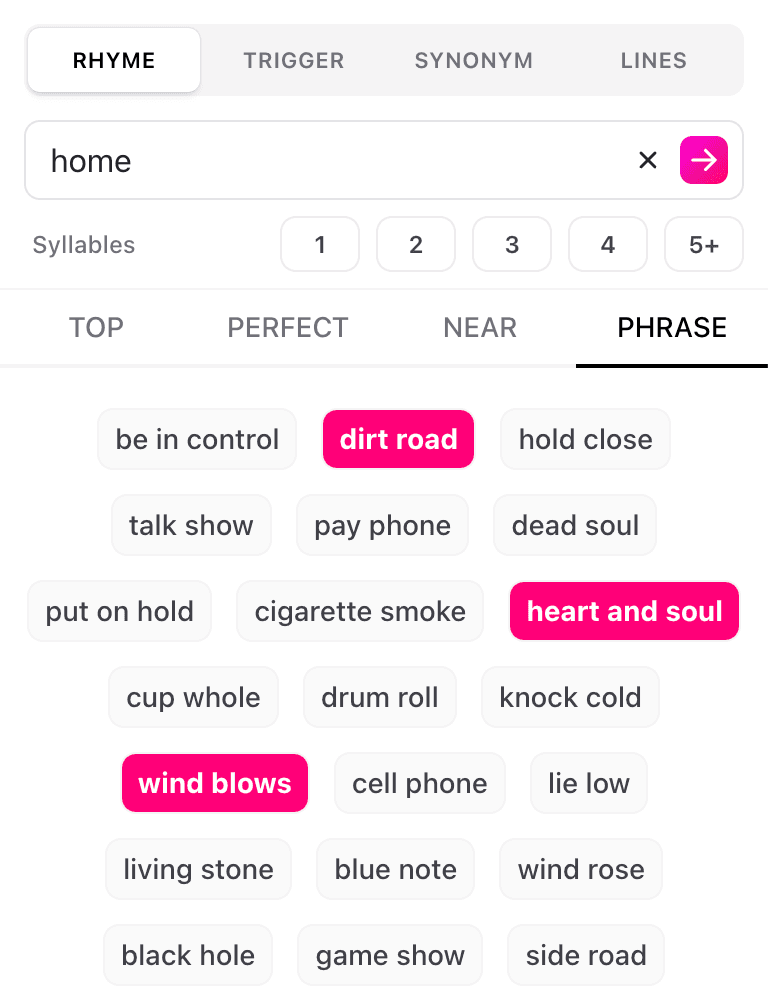
A simple way to use it:
- Start with an unfinished line and search its ending.
- Compare several phrase results rather than taking the first one.
- Notice which are perfect rhymes and which are near rhymes.
- Rewrite the strongest option around your own character, setting or experience. Try Chorus with one unfinished lyric and find a rhyme that helps you finish the thought, not just the line.
FAQ
What is a phrase rhyme?
A phrase rhyme is a rhyming suggestion made up of a short phrase, such as "left the light" for "night," instead of a single word. Because phrases include actions, objects or images, they give you a direction for the line, not just a sound to match.
What is a near rhyme (slant rhyme)?
A near rhyme, or slant rhyme, is a pairing where the sounds are similar but not identical. Usually the vowel sounds match but the consonants differ, as with "home" and "road," or the reverse. Songwriters use near rhymes constantly because they offer far more choice than perfect rhymes.
What is a multisyllabic rhyme?
A multisyllabic rhyme matches two or more syllables instead of just the last one, such as "came home" and "pay phone." They add rhythmic weight to the end of a line and can make lyrics feel more intricate and intentional.
Do song lyrics have to use perfect rhymes?
No. Many successful songs rely on near rhymes, and some use perfect rhymes only at key moments like the chorus. The right choice depends on the feel you want: perfect rhymes for certainty and closure, near rhymes for a looser, more natural sound.
How do I rhyme when I'm stuck on the last word of a line?
Instead of searching for the word alone, search the last two or three syllables of the line and look at phrases. Choose the one that suggests a scene or feeling you can use, then rewrite it in your own words.