Avoiding chord clichés
8/11/2026
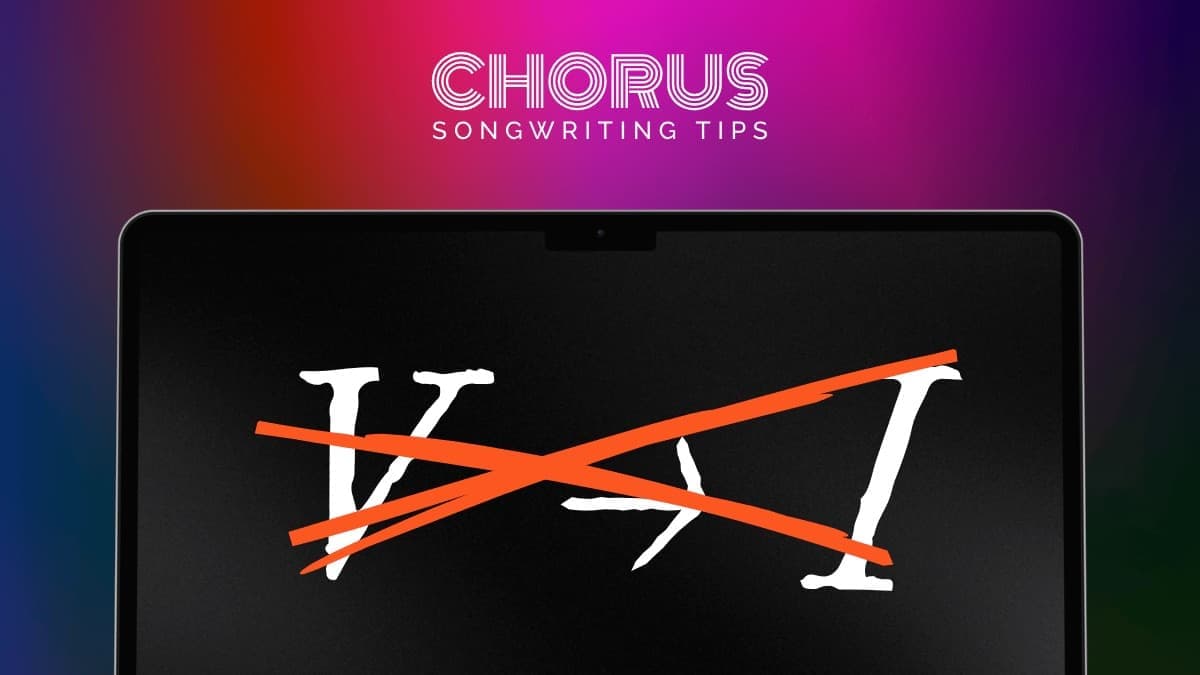
We’ve all built or played a sequence that lands on a standard V7→I resolution and felt that slight sting of cheese. It’s a bit "ta-da", predictable and often too cliché for a modern track.
There are a few quick escape hatches you can try to avoid these kind of clichés without having to rewrite what you've done - you can just drop them in and smooth everything out.
If V7 and I are still new, Basic music theory for songwriters covers what the numbers mean, with examples you can play.
1. The IV/V - a softer dominant resolution
If you take only one swap from this list, make it this one.
Instead of hitting a straight V or V7 before going home to I, play the IV triad over the 5 in the bass. In the key of C, that means playing an F major triad with a G in the bass (F/G).
Why it works
Your bass note stays firmly on G, so the structural "push" back to C doesn't change at all. But up top, you’re dropping the sharp leading-tone pull (B→C) in favor of a clean, floating V11^sus4 sound.
Where to use it
Literally anywhere you have a dominant chord resolving down a fifth. Going from E→A? Swap the E for D/E. Going from D→G? Use C/D. It’s a 100% direct drop-in.
This is famously used in the song "Easy" by The Commodores, and it keeps a smooth, soulful sound but still has the pull back to the I.
2. The ii7/V (The Jazz-Pop Lift)
This is a close cousin of the IV/V, but it leans just a tiny bit richer.
Take a standard V7 and swap the upper structure for a ii7 chord while keeping the 5 anchored in the bass. In C major, you’re playing Dm7/G.
Why it works
In terms of notes, Dm7 (D-F-A-C) is basically just an F triad with an extra D tacked on the bottom. Holding that G in the bass gives you an open, atmospheric resolution that feels urban and smooth.
Where to use it
Perfect for R&B, modern pop, or neo-soul turnarounds where a standard V feels too dry, but you still want an effortless transition back to the root. Again, you can drop this in to replace any V7→I in your song.
3. The Subdominant Minor Drop (IV→iv→I)
Technically a two-chord combo, but it functions as a single drop-in unit for any basic IV→I resolution.
If your sequence moves from F→C, insert the minor version of the IV chord right before landing on the tonic (F→Fm→C).
Why it works
You aren't changing the bass root. You’re just creating a smooth, descending chromatic line in the middle of the chord (VI→♭VI→V, or A→A♭→G in C major). It trades simple brightness for instant nostalgia and emotional weight.
Where to use it
End of verse sections or bridge climaxes where you want the resolution to hit with a bit more feeling without altering the song’s rhythm.
Summing up
The best part about these three is that they don't force you to change the overall shape of your own song or adjust the melody. They just give what you already have a bit more breathing room.
Try these next time you're writing and you think the V7→I resolution is what you need but not what you want!